4 min read

Why Most Condition Management Programs Fall Short—and How Brokers Can Do Better

Why Most Condition Management Programs Fall Short—and How Brokers Can Do Better
Condition Management’s Cost Crisis
9:15

Key Highlights:

  1. The Cost Pressure Employers Could Absorb—Until Now
  2. Why Most Condition Management Programs Fall Short
  3. What Makes a Condition Management Program Actually Work
  4. How HealthCheck360 Turns Engagement into Measurable Compliance
  5. Watch Cost Savings Compound Over Time
  6. Why Brokers Should Care

 See How HealthCheck360’s Condition Management
Program Saved $3.6 Million in Avoided Costs


The Cost Pressure Employers Could Absorb—Until Now

Employer healthcare costs continue to rise faster than inflation, driven by higher utilization, hospital prices, and prescription drugs—pushing self‑funded employers to elevate their search for profound cost‑containment strategies. Meanwhile, chronic and complex conditions account for a disproportionate share of spending in employer-sponsored plans. That concentration makes the problem more painful and more solvable, but only if employers can engage the people driving the majority of claims.

The problem isn’t awareness—employers know chronic disease is expensive. The real issue is execution. Too many programs fail to engage the highest‑risk members, leaving employers stuck with the same cost trend year after year.

Why Most Condition Management Programs Fall Short

Benefits advisors know this story well: A client adds a disease management program to their benefits plan, hopes for lower costs, and a year later the cost trend hasn’t budged. The employer questions the investment, and the broker is left defending a well-intentioned program that didn’t move the needle, creating a difficult renewal conversation.

Why does this problem continue year after year? Three common program types consistently underperform:

1. Voluntary Opt‑In Programs

These models rely on members raising their hand—usually the people already managing their health. The members driving costs rarely opt in, leaving the employer with low participation and no measurable ROI.

2. Carrier Disease Management Programs

Carriers may report a disease management program is running, but often brokers experience:

  • Minimal visibility into what’s happening.
  • Low engagement.
  • Very little connection between activities and actual outcomes.

These programs often rely on member self‑reporting or light-touch outreach, creating no real accountability.

3. Tech‑Only or App‑First Point Solutions

Digital tools can be helpful for their convenience, but on their own, they rarely change behavior. Apps without human support or claims‑verified compliance tend to attract only motivated members.

Across all three model types, the pattern is the same: High‑risk people don’t engage. And costs don’t change.

What Makes a Condition Management Program Actually Work

Brokers and employers need more than a passive program or point solution. They need a clear framework for evaluating what actually works. High-performing condition management programs share four critical characteristics:

1. Claims-Based Identification

Self-referral alone isn’t effective. When programs rely on voluntary enrollment, they consistently miss the members who drive the most cost. Claims-based identification ensures everyone with a chronic condition is included—not just those motivated enough to sign up.

HealthCheck360 saw this firsthand in a captive of 36 employers. Claims review found that 41% of captive members had at least one chronic condition. Typical opt-in programs reach only 5-15% of eligible members, leaving most high-risk individuals outside the program.

2. Support That Drives Completion of Clinical Care

Beyond just enrollment, effective condition management also must focus on supporting and monitoring members as they work closely with their healthcare provider to complete evidence-based clinical care requirements tied to their chronic condition(s). Strengthening the patient-provider relationship reduces complications, specialist visits, emergency room use, hospital inpatient admissions, and unmanaged disease progression.

Going back to HealthCheck360’s captive example, auto-enrollment brought 1,805 high-risk members into the program, with 87% remaining compliant throughout the plan year. When members are supported, they stay engaged.

3. Verified Compliance, Not Reported Participation

Engagement alone doesn’t change outcomes. Employers and brokers need verified data showing whether members are filling medications, completing labs, and seeing their physicians. Claims-verified compliance provides objective visibility into whether care is actually happening.

In the captive, claims-based tracking showed medication adherence improved from 29% to 54%, delivering progress that engagement-only models can’t reliably produce.

4. Incentives Tied Directly to Required Behaviors

When incentives are designed as accountability tools, or penalties, they consistently outperform engagement‑only strategies. Tying incentives to specific, evidence‑based care requirements reinforces follow‑through and sustained behavior change.

For the captive, incentives improved compliance across diabetes, high blood pressure, and high cholesterol management compared to voluntary programs. See how incentives influenced compliance improvement in the case study.

How HealthCheck360 Turns Engagement into Measurable Compliance

This is where HealthCheck360 differs from other programs. Rather than relying on passive engagement, our program is designed to consistently reach, support, and hold accountable the members who need it most—and who drive the most cost.

Members receive consistent, structured support through a coordinated system that includes:

  1. Persistent, personalized outreach from certified nurses and health coaches.
  2. Guided condition‑specific action plans.
  3. A mobile app tool for medication reminders, lab prompts, and care checklists.
  4. Real‑time progress tracking tied to claims-verified data.
  5. Regular follow‑ups to close care gaps.
  6. Incentives tied to compliance.

For members managing multiple chronic conditions—where confusion, overwhelm, or competing priorities can break down care plans—this multi-layered approach boosts accountability by creating clarity, urgency, and consistent follow‑through.

Watch the Cost Savings Compound Over Time

When members consistently follow clinical guidelines—and that completion is verified through claims data—health plan costs start to shift. Improved medication adherence, timely lab work, and regular provider visits reduce preventable complications and interrupt the progression of chronic disease before high-cost events occur.

HealthCheck360’s condition management program delivered measurable financial impact across the captive:

  • $3.6 million in avoided costs in year one.
  • $3,454 savings per compliant member.
  • Near 15:1 ROI across the captive.
  • Members compliant for two consecutive years cost 36% less than non-compliant members.

Claims reduction grows year over year because members who stay complaint stabilize their conditions, reducing emergency care, acute events, and unmanaged disease progression. This is the kind of defensible cost containment benefits brokers need to differentiate themselves and retain cost‑sensitive clients.

Why Brokers Should Care

For advisors supporting self‑funded plans, high‑quality condition management checks every strategic box:

1. Fast and Defensible ROI

Condition management delivers measurable, repeatable financial impact year after year when supported by claims-verified data that brokers can confidently stand behind.

2. Solves the Engagement Gap Other Programs Leave Behind

While automatic enrollment alone doesn’t lead to participation, combining it with claims-verified compliance and incentives drives objective outcomes from the members who have the greatest influence on plan spend.

3. Transparent, Objective Reporting

Brokers can show clients real outcomes, including reduced PMPY trend and improved clinical compliance.

4. Lower HR Burden and Risk

HealthCheck360 manages sensitive clinical work, so HR teams stay out of employee’s protected health information and avoid administrative overload.

Let’s Talk Strategy

For self-funded employers facing another year of rising claims, the path forward requires chronic condition management that pairs engagement with verified compliance. HealthCheck360’s condition management program delivers structured accountability, personalized support, and measurable financial impact brokers can take directly to their clients.

If you're looking for a condition management partner that strengthens your recommendations—not complicates them—HealthCheck360 is built to support you. Speak with one of our consultants to understand how our approach delivers engagement, compliance, and measurable cost impact your clients expect. 


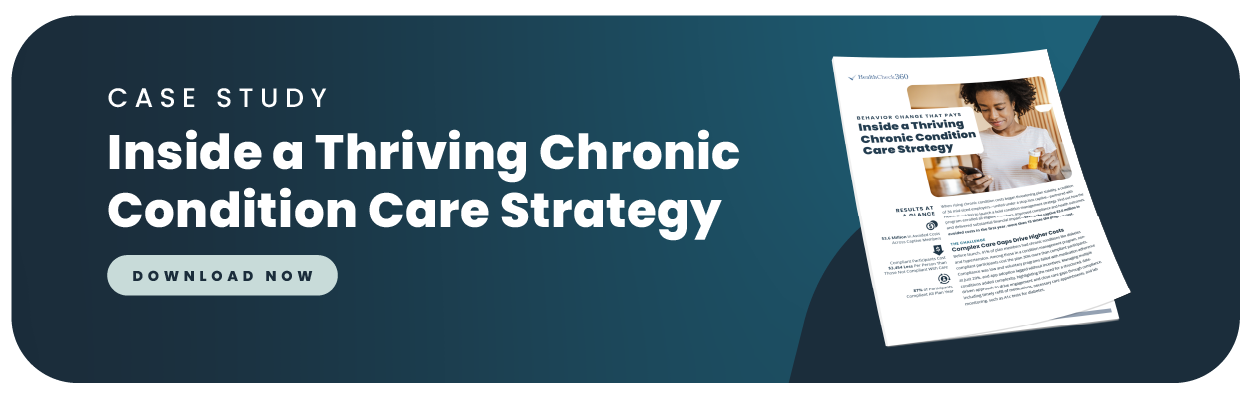
See How Verified Compliance Delivered $3.6M in Avoided Costs
Download our one-page condition management case study now!

CMP Blog images-50

Free Resource: April 2026 Well-Being Calendar

Free Resource: April 2026 Well-Being Calendar

Artificial intelligence (AI) is quickly becoming part of everyday life—from how we work to how we communicate. But AI’s impact doesn’t stop at...

Read More
On-Demand Coaching Webinar | Choosing Healthier Convenience Foods

On-Demand Coaching Webinar | Choosing Healthier Convenience Foods

Many people struggle to eat healthy when life gets busy, and this upcoming HealthCheck360 webinar offers simple, practical guidance they...

Read More